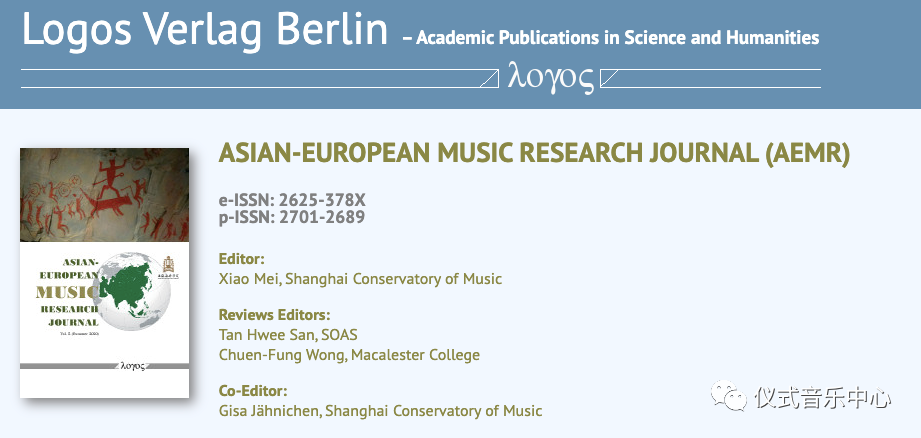
《亚欧音乐研究》英文期刊(AEMR)
2021年夏季号(总7期)
【e-ISSN 2625-378X】
【p-ISSN 2701-2689】
本期刊是一本全英文双盲同行评审学术期刊,发表关于传统音乐、流行音乐、田野考察以及近期亚洲和欧洲关注的热点议题和争论焦点的相关研究成果。本期刊由“上海音乐学院·亚欧音乐研究中心”主办,期刊特别强调亚洲和欧洲文化以及亚洲和欧洲在时空上的互联与互通。期刊自2018年创立以来共发布7期。除了线上发布外,本刊的纸质版由德国柏林逻各斯出版社出版发行。
《亚欧音乐研究期刊》自发刊之初即被“国际音乐资料大全”(RILM)作为核心期刊收录,随后于2020年7月为“欧洲人文社科参考文献索引”(ERIH PLUS)收录,继而又于同年11月份被全球规模最大的同行评议文献摘要和引文数据库Scopus所接受。而在2021年开端,又进一步被开放获取期刊目录(DOAJ)收录。
本期刊网站为:https://www.logos-verlag.de/cgi-bin/engtransid?page=/aemr-issues.html&lng=eng&id=
点击本文下方“阅读原文”可自动跳转《2021年夏季号(总7期)》,欢迎关注!
Articles(论文)
1."The Transtextual Gender Construction in the Opera Madame White Snake"
歌剧《白蛇传》的跨文本性别建构
Fang Bo[方博](香港中文大学)
Abstract:The opera Madame White Snake (hereafter Madame), co-commissioned by Opera Boston and Beijing Music Festival, premiered at Boston Cutler Majestic Theater in February 2010. It was the first commissioned opera by Opera Boston.Based on the story from the famous Chinese ancient myth Bai She Zhuan (in Chinese: 白蛇传), this opera’s libretto was created by a Singaporean American librettist, who has shed the story’s “traditional skin and taking on modern trappings” (Smith, 2019: 27) on purpose. When sniffing at male librettists’ discourses about female characters’ vulnerable and tragic lives in their operas, opera Madame’s initiator and librettist Cerise Lim Jacobs argues that women should seize the initiative to make their own decisions in life. The white snake, in her mind, ought to be a whole woman who is powerful and demonic, and yet, is also nurturing and caring, is capable of deep and intense love. In the first section of this article, I introduce the original legend’s background and the story outline in its operatic adaptation; I also trace back the opera’s commissioning process. After providing the background information of the story and the operatic version, then, in the second section I analyze the opera in terms of its transtextual figural gender construction in her characterization through comparative studies of the white and green snakes’ images from the sources of literary works, traditional xiqu scripts and operatic librettos. Referring to Lim’s personal growth and migrating history, as well as she and her husband co-founded charitable foundation’s missions and its recent IDEA (Inclusion, Diversity, Equity, and Access) opera grant program partnering with Opera America, I aim to examine her gender construction of the “female” roles in the opera from the perspectives of feminism, interracial marriage; and heterosexual, transsexual, and homosexual relationships.
Keywords: Opera, Chinese drama, Legends, Gender construction
2."Symphonies, Status and Soft Power: The Symphony Orchestra of India"
交响乐、地位与软实力:印度交响乐团
Hannah Marsden(英国罗汉普顿大学)
Abstract:The Symphony Orchestra of India (SOI) is India's only professional symphony orchestra. In this paper, I explore the roles and meanings of the SOI. First, I situate it locally within its home city of Mumbai, positioning it within discourses of social class, status, and globally-minded aspiration. I argue that local values and ideologies surrounding professional musicianship compromise attempts to embed orchestral musicking in the city. I then move on to place the SOI within discourses of nation building, questioning the role of the orchestra as a marker of national development. I suggest that Mumbai's transnational middle class and elite communities, as well as the SOI's multinational corporate donors, consider investment in an orchestra a part of India's wider political and economic development. I point to tensions that are created as India's local and national government resist the notion of the orchestra as a marker of modernity and instead champion Indian arts and cultures as foundational to India's nationhood. Finally, I explore the SOI’s transnational networks, looking at its role within cultural diplomacy and soft power. I show that, whilst the SOI has made significant steps in ‘reaching out’ and finding a place within transnational cultural networks, its efforts are hampered by its failure to ‘stand out’; to forge its own national identity as an Indian symphony orchestra.
Keywords:Orchestra, India, Mumbai, Soft Power, Cultural diplomacy.
3."Genre Localization in Current Popular Music of the Philippines"
菲律宾当代流行音乐体裁的在地化
Li Jia [李嘉](山西师范大学)
Abstract :This paper focuses on the process of genre formation in the evolution of popular music of the Philippines’. From the phenomenon of the perception discrepancy of popular music genres among different stakeholders, this paper gives to attention at providing an alternative theory to explore how the Philippines’ popular music genres have been established. Applying Joe Peter’s theory of cultural hybridism, this paper specifically attempts at exploring how foreign genres have been fused with local cultures and musical components, aiming at a vocality of expressing the Philippines’ national identity, which is key in articulating Philippines’ popular music genres in their actual sense. Rather than a parodic emulation of foreign music products, genre fluidity is a unique reflection of the artistic wisdom of Philippines’ musicians in the pursuit of forming a voice of their own, a continuation of their nationalist movement in their popular music idioms.
Keywords:Cultures of the Philippines, Genre, Popular music, Localization
4."What is Known About Some Music Features and Song Lyrics of the Khmer Living in the South of Vietnam?"
有关越南南部高棉人的音乐特征和歌词,我们知道些什么?
Nguyen The Truyen [Nguyễn Thế Truyền](越南文化体育旅游部)
Abstract:In this article, the author will present some research issues as follows: Musical expressions of love for the homeland, Love among men and women, family affection, and attachment to work. The Khmer inhabiting South Vietnam practice all these expressions. In another short section, common characteristics with the music of other ethnic groups in Vietnam include similar instrumental music, scales used and rhythmic structures applied. Thereby, the author reviews categorizations undertaken in the past demonstrating that Khmer music strictly belongs to one ethnic group in the country. Also, musical instruments have been categorized in similar ways, using the Hornbostel-Sachs descriptive tools: Chordophone, Arephones, Idiophones, Membraphones, which are using a variety of scales and modes. It is also said that the inheritance and promotion of the typical values of Khmer music into social life, was a very pragmatic fact, which needs more attention. The use of the term “Folk Music” is only reflecting on a certain approach supported by cultural policies toward minorities from the 1970s to 2010.
Keywords: Khmer music, Khmer instruments, Khmer songs, Southern Vietnam.
5.“Leuangtengdong: Analysis of a Hmong Song”
“Leuangtengdong”:一首苗族歌曲的分析
Paula Stefanini(上海音乐学院)
Abstract:This article is an analysis of “Leuangtengdong”, a Hmong song melody which was recorded and transcribed by Jähnichen in 2000, while documenting a collection of Hmong songs in Laos. This new article is an effort to analyze melodic patterns of the song while considering its historical and social contexts through the personal gaze of the author with a specific background in singing and social experience. It is important to mention that the language sung in the song was unknow and that the emphasis of the analysis is on the musical shape. Finally, there is a conclusion regarding this song fitting in Jähnichen’s hypothesis on Hmong song melodies which states that most musical phrases do not repeat; all lines are different in pitch, order and length; pitch order and intervals can indicate a specific type (of song); singers do not know which type they sing, only analysis shows; and analysis cannot prove ethnic groupings. "Very interesting is the general characteristic of generating absolutely individual melodic lines in each example and in all the other recordings there was no one song with a repetition of a single melodic line. Avoiding repetitions is therefore a remarkable sign of Hmong song melodies.”(Jähnichen, 2011: 126). The given core hypothesis was the point of departure in this analytical article.
Keywords:Hmong, Wedding song, Pitches, Intervals, Tonal language
6.“Understanding an Epic Song of the Hmong in Laos From The Perspective of Oral Composition”
从口头创作看老挝苗族史诗
Zhang Xun [张寻](上海音乐学院)
Abstract:This article looks at an epic song performed by Hmong in Laos from a perspective of oral composition by analyzing a wedding song Leuangtengdong. Through detailed musical and textual transcription,several compositional devices are identified and discussed. My study explores oral composition of the song focusing on its material and structure. I argue that music plays an important role in its oral composition: material-wise, music functions both as formulaic music-text association/unity and by careful music-text interactions; structure-wise, the song is organized in a multi-layered framework realized by the hierarchical music-text formulas, with music-text ‘theme’ in critical structural positions.
Keywords:Hmong, Epic song, Oral composition, Music, Laos
7."Home-Coming: The Repatriation of Historical Recordings"
归家:历史录音的“反哺”
Ling Jia Sui [凌嘉穗](上海音乐学院)
Abstract: This article deals with the provocative questions of repatriating recordings stored in large and small archival institutions, mainly audio or video recordings, to source communities. While this topic is often, disputed within the framework of sound and audio-visual archivists, it is rather rarely, investigated with academic vigor based personal experience in the field of music research. This paper attempts to start closing the knowledge gap and exchange ideas between those with practical experience and those with musicological background but not necessarily intense experiences. The article provides an in-depth understanding of the term ‘home-coming’ and how this term relates to future activities and directions to be considered by museums and archival institutions. These insights might be of great benefit in sustaining and developing today’s archival institutions in Asia and Europe.
Keywords:Repatriation, Archives, Historical audio recordings, Community connections, Global musicology
Reviews(评论)
1."Book Review of ‘Kirsten Seidlitz. 2020. Musik\& Politischer Konflikt aus der Türkei-kurdische, alevitische und linke Musik in Deutschland’ [Music and Political Conflict from Turkey – Kurdish, Alevi, and Leftist Music In Germany]. Bielefeld: Transcript"
评:克尔斯滕·塞德利茨《土耳其的音乐与政治冲突——德国的库尔德、阿列维和左派音乐》(比勒费尔德抄本,2020)
Gisa Jähnichen(上海音乐学院)
Abstract :This short review essay refers to the book of Kirsten Seidlitz ‘Musik & Politischer Konflikt aus der Türkei-Kurdische, alevitische und linke Musik in Deutschland [Music and Political Conflict from Turkey-Kurdish, Alevi, and Leftist Music in Germany], which was published in 2020 by the German Transcript Verlag in Bielefeld. It is written in German and addresses many important questions regarding political conflicts and their impact on music among various different Turkish people living in Germany. Migration and political participation are heatedly debated in recent times and also a part of cultural exchange.
Keywords: Book review, Migration, Musicians, Political conflicts
2."Review Essay: Why Was this Colloquium on Drums and Drum Ensembles Along the Silk Road Important in these Times?"
会议评述:为什么ICTM“丝绸之路上的鼓与鼓乐”研讨会在当下如此重要?
Aly Abdelaty Ebrahim Hassan [على عب د العاطي ابراهيم حسن](上海外国语大学)
Abstract: This short review essay aims at answering the question “Why was this Colloquium on Drums and Drum Ensembles along the Silk Road Important in these Times”? It was the very first gathering on this topic I experienced. I could meet experts as an amateur since I only recently dealt seriously with music. I wanted to share my ideas and I could learn a lot, too. However, I think that this mutual learning is the most important. The colloquium was to a great part to increase interest in many details about which we do not know yet.
Keywords: International Council for Traditional Music (ICTM), Colloquia, Mutual learning, Knowledge exchange
3."Review of ‘Ziying You. 2020. Folk Literati, Contested Tradition, and Heritage in Contemporary China: Incense is Kept Burning’"
评:游自荧《当代中国的民间文人、争议中的传统和遗产:香火不断》(2020)
Corey Moore(上海音乐学院)
Abstract :This is a short review of the publication by Ziying You on “Folk Literati, Contested Tradition, and Heritage in Contemporary China: Incense is Kept Burning”, which was released by Indiana University Press in Bloomington in the year 2020. The topic is highly sensitive to current efforts in reworking writings on historical developments in China. This review is important due to the fact that it allows many people to access details of the topic and to start a future discourse about some of the arising questions on heritage and historical values as well as about grassroot intellectuals and existing power structures.
Keywords: China, Folk, Literati, Tradition, Heritage
4."Review of ‘British Forum for Ethnomusicology (BFE) Annual Conference, 8-11 April 2021’"
会议评述:“2021年英国民族音乐学论坛(BFE)年会(4月8日-11日)”
Aniarani Andita & Aditi Krishna(伦敦大学皇家霍洛威学院)
Abstract :This is a review of an event. The event was the ‘British Forum for Ethnomusicology (BFE) Annual Conference, 8-11 April 2021’, which was held online due to actual circumstances of limited mobility. Both writers attended and shaped this review through their personal thoughts based on accessible information.
Keywords: Review, Event analysis, British Forum for Ethnomusicology, Online discussions
主编:
萧梅(上海音乐学院)
合作主编:
Gisa Jähnichen(上海音乐学院)
评论编辑:
Tan Hwee San(伦敦大学亚非学院)
黄泉峰(美国玛卡莱斯特学院)
编委会(以姓名首字母排序):
Ako Mashino(日本东京艺术大学)
Alexander Djumaev(乌兹别克斯坦作曲家联盟)
Chinthaka P. Meddegoda(斯里兰卡科伦坡视觉和表演艺术大学)
Chow Ow Wei(马来西亚普特拉大学)
Earl Jimenez(菲律宾女子大学)
Esbjörn Wettermark(瑞典Gävleborg文化发展办公室)
Helen Rees(美国加州大学洛杉矶分校)
刘红(上海音乐学院)
徐欣(上海音乐学院)
Razia Sultanova(英国剑桥大学)
Tan Shzr Ee 陈诗怡(伦敦大学皇家霍洛威学院)
本英文电子期刊每年分两期上线:
六月(夏季)和十二月(冬季)。
欢迎投稿!
投稿邮箱:AEMRC@shcmusic.edu.cn
b站账号:仪式音乐中心
课程、讲座及工作坊视频持续更新中
目录:
(1)萧梅《多元文化中的唱法分类体系》
(2)林晨《减字谱中的音乐形态》
(3)萧梅《“谁的呼麦”——亚欧草原寻踪》
(4)宁颖《从朝鲜族“盘索里”表演看“长短”的生成逻辑》
(5) 崔晓娜《从音乐实践看“旋宫不转调”——以河北“十番乐”为例》
(6)萧梅 《多元文化中的歌唱方法与表演专题》第一课
(7)萧梅 《萨满(巫)仪式音乐中的“制度性展演”》
(8)杨玉成 《传统音乐的“逆向”重建——以蒙古族科尔沁英雄史诗的活化演唱实验为例》
(9)粤东海丰陶塘(下元节)礼俗纪实
(10)上双·生态联盟 | 苗族工作坊:如水·漂泊·交融——我与苗族务工阿姨的魔都之歌
(11)施吟云《苏州评弹表演中的“非语言”交互性研究》