

“中心”研究员参加ICTMD全球音乐舞蹈史分会第四届研讨会(德国·柏林)
2025年9月18-21日,上海音乐学院“中国仪式音乐研究中心”和“亚欧音乐研究中心”研究员参加了在柏林举办的国际传统音乐舞蹈学会(ICTMD)全球音乐史分会第四届国际研讨会。
本次研讨会的主题是“音乐史上的放大镜:通过传记的生活和表演”(A magnifying glass on music history: lives and performances through biographies),聚集了来自20多个国家60余位发言人。正如分会主席拉齐亚·苏丹诺娃(Razia Sultanova)在开幕式致辞中提出的问题:“为什么要书写传记”?(Why "Biographies")通过4天研讨中许多音乐家、理论家、作曲家等人物生平和表演经历的叙述及其阐释,的确令我们窥见多元文明与文化中一面面映照历史和社会的放大镜。
来自柏林民族学博物馆、国立博物馆和亚洲艺术博物馆的莫里斯·蒙格尔(Maurice Mengel )教授和来自爱尔兰科克大学的乔纳森·斯托克(Jonathan Stock)教授分别为大会做了主旨演讲。
莫里斯教授的演讲以“如何层层打破历史的中心叙事?对普世史、世界史以及全球史的反思”(Decentering History Iteratively? A Retrospective of Universal, World, and Global Historiographies?)为题,旨在开启一场关于历史学如何能够不断去中心化的对话,而这一持续的过程本身并非最终目的,而是一个反省的过程以适应不断变化的政治、文化及认知现实。他在演讲中回顾了各种史学研究方法,从亚历山大·冯·洪堡(Alexander von Humboldt)的开创性构想开始,一路追溯到像沃尔特·米格诺洛(Walter Mignolo)这样的当代思想家。此外,他还重新审视了民族音乐学历史上的重要贡献,比如如何看待所谓比较音乐学“柏林学派”的研究,以理解这些知识传统如何与更广泛的史学辩论相互交织的历程,在突破“欧洲中心”框架的历史叙述中,思考沿袭自启蒙运动的线性进步观念来构想历史是否仍然具有建设性?还是说,我们是否必须放弃这一传统,转而发展出新的词汇和框架,以便更准确地反映当今全球历史的复杂性呢?如此等等。
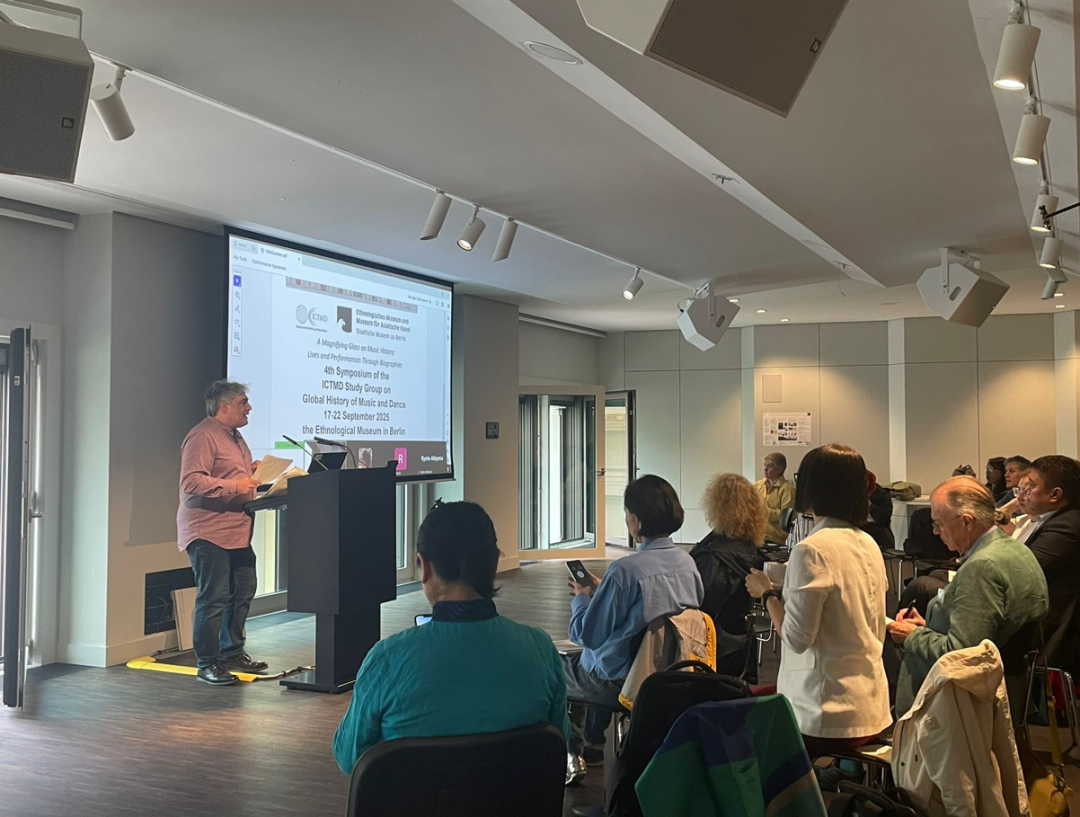
莫里斯教授在发言中
乔纳森(施祥生)教授的主旨演讲题为“从‘伟人’到日常生活研究:传记作为一种全球音乐史的研究方法”(From ‘Great Men’ to the Study of Everyday Lives: Biography in/as Global Music History.) 他在演讲中回顾了民族音乐学者研究和呈现音乐创作者生活经历的各种方式。将民族音乐学关注概述性的民族志而非个人传记的关系与民俗学界兴起的手机和分析生活故事的趋势,以及人们如何讲述自己的历史做了比较。他认为这些讲述本身就是一种文化表现形式,也是民族音乐学重新确立的历史立场的一部分。在民族音乐学家中,这也与探索个人在文化创造和维护过程中的多样化角色、途径和经历的行动有关。他在针对20世纪90年代所探索的人物传记写作实践、以及影片拍摄等体裁的回顾中,进一步提出自己对传记研究的思考——涉及对杰出音乐家的人生故事与社会日常生活的关系——不是回到对“一般性”(average)经历的鼓吹上,而是以一种试图解释为何这种非凡之事会成为日常生活中不可分割的一部分。
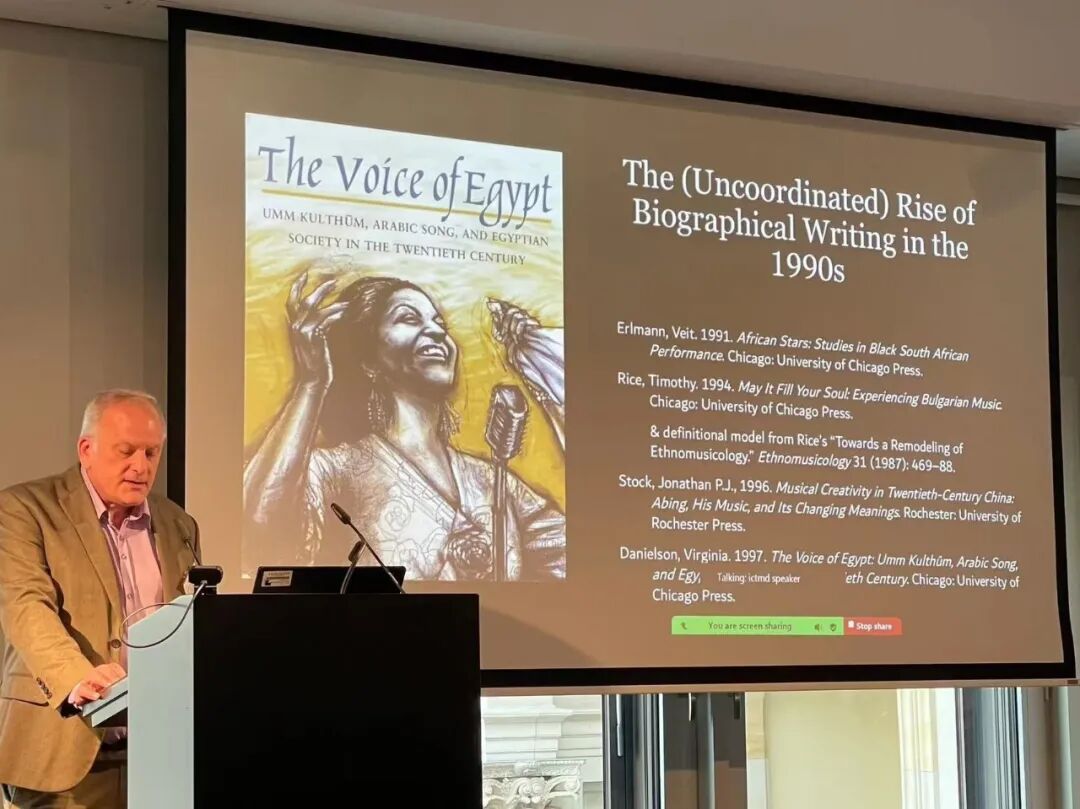
乔纳森(施祥生)教授在发言中
在本次研讨会上,来自上海音乐学院东方乐器博物馆的邢媛博士以《沈正国:一手持锉、一手执笔的乐器制作师》(Shen Zhengguo: An Instrument Maker Who Holds a File in One Hand and a Writing Brush in the Other)为题,讲述了中国传统乐器制作领域一位不多见的、身兼乐器制作、修复、摄影、研究、传播等多重身份的复合型乐器制作师的人生故事及其价值。
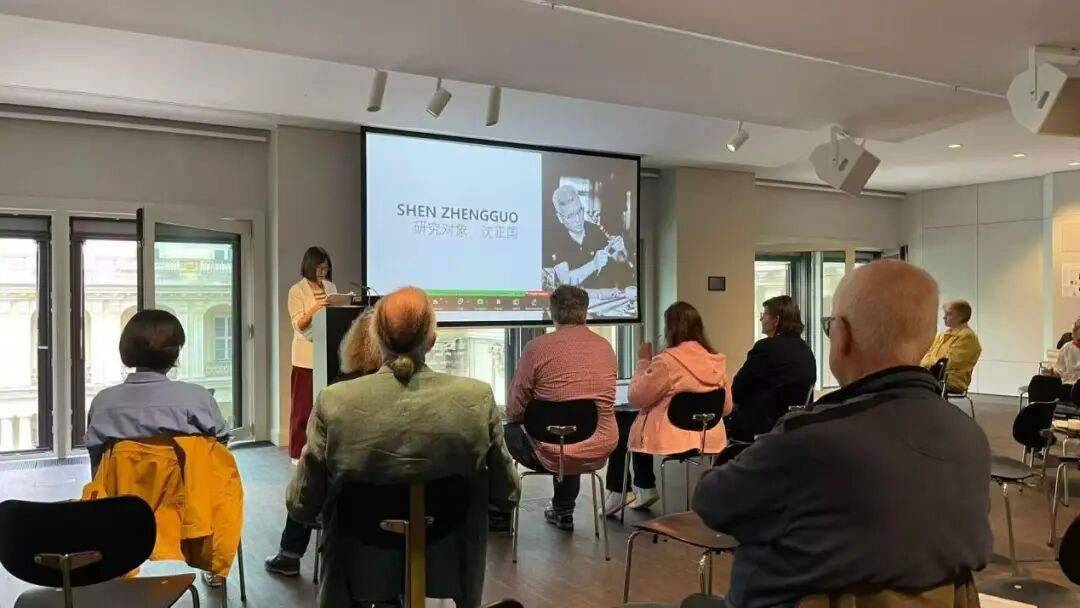
邢媛博士在发言中
Abstract: Shen Zhengguo is a rare versatile traditional Chinese musical instrument maker in the field of traditional Chinese musical instrument craftsmanship, who holds multiple roles including instrument making, restoration, photography, research, and promotion. When he entered the field of traditional Chinese musical instrument making, it coincided with the end of China's planned economy era. This special historical stage provided unique opportunities for his growth.
During Shen Zhengguo's tenure managing the Shanghai National Musical Instrument Factory, China's musical instrument industry established a public-owned production system, and Chinese musical instruments began to enter the global market. As a leading enterprise in the production of Chinese national musical instruments, the factory undoubtedly pioneered the development trend of China's musical instrument industry. Over his more than 30 years at the factory, Shen progressed from an apprentice to a manager, and from instrument making to research; he participated in and witnessed the development of Chinese national musical instruments. After leaving the factory, he designed musical instruments, replicated and restored ancient musical instruments, curated exhibitions, and published monographs. He also collaborated with string makers from Japan and performers from Australia, and carried out joint research projects with the Dunhuang Academy, the Deutsches Museum, and the Metropolitan Museum of Art.
Shen Zhengguo devotes himself to studying craftsmanship with a file in one hand and documenting heritage for inheritance with a pen in the other. His work has not only promoted the continuous improvement of the craftsmanship level in the making and restoration of Chinese musical instruments, but also recorded the stories and preserved the names of musical instrument makers who were once on the "margins" of society. This has not only endowed the craftsmanship of traditional Chinese musical instrument making with cultural depth, but also added a human touch to it. He has deeply engaged in the exploration and research in the field of traditional Chinese musical instrument making, providing key support for the research on the collection of Chinese musical instruments worldwide and promoting the deepening of the research process in this field.
来自上海音乐学院音乐艺术研究院的徐欣研究员发表了论文《个体的桥接角色:布林巴雅尔与蒙古族马尾胡琴》(Bryn Bayar and the Mongolian Horsetail Huur in China),她的论文通过布林巴雅尔的学术人生,透视百年来中国蒙古族马尾胡琴乐器家族在内蒙古草原不同部落和地区传承、发展和变革的过程,并揭示了布林巴雅尔的理论与实践如何深刻影响了当代中国蒙古族马尾胡琴类乐器的现状和发展方向,并通过关照个人传记的撰写角度提出,尽管当下学界更为关心的是曾经被忽视的所谓“边缘人”,但“大人物”的传记书写同样值得重新考量,核心问题应该是“我们需要什么样的传记”。
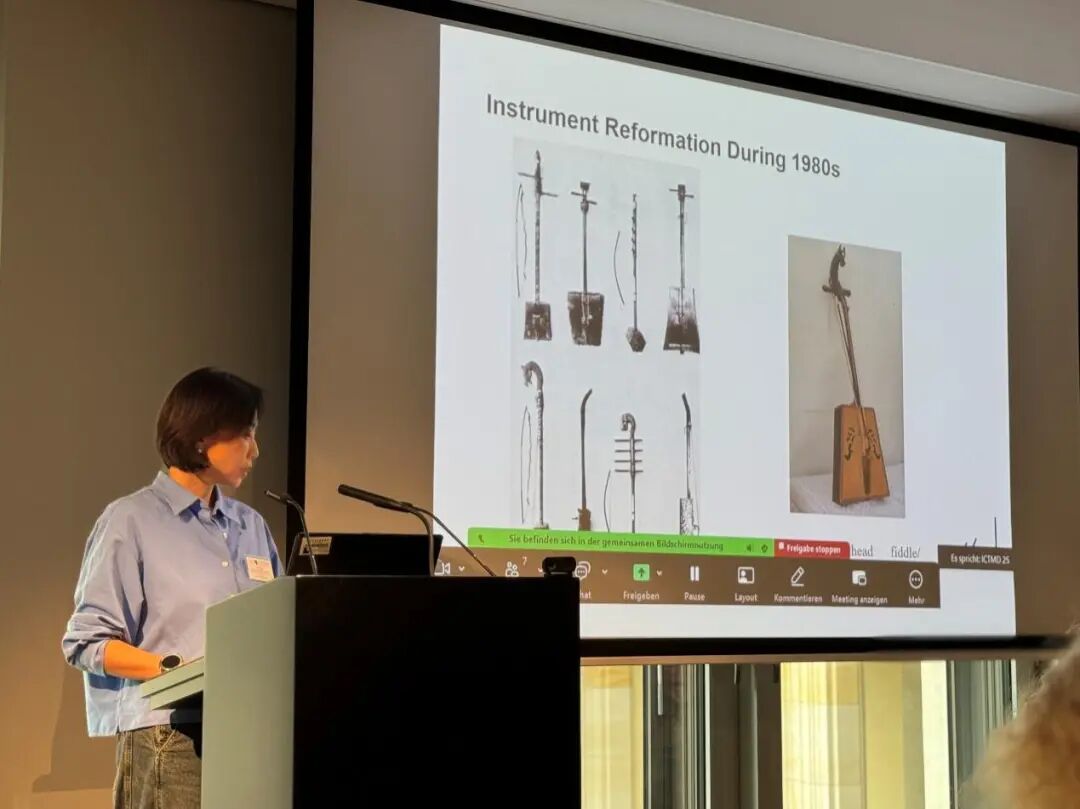
徐欣研究员在发言中
Abstract:From November 1-3, 2024, Inner Mongolia Arts Institute and other 8 institutions hostedanconference with the theme of "Mr. Bryn’s Horsetail Huqin Inheritance and Innovation ", including a Mongolian concert, a forum and a documentary section, more than 100 performers scholars participated in the conference to pay their respect to Buryn Bayar, the 85-year-old horsetail fiddle (or horsetail huur) master in Inner Mongolian, China. It is not common to hold such a big academic event for a living master, which represents the irreplaceable role Bryn Bayar playedforthe performance, research, and inheritance and development of Chinese Mongolian bowstring instruments. Bryn Bayar is not only a performer, composer,researcher, but also an educator. His lifebearsthe evolution history of the Mongolian horsetail huur in China over the past hundred years, reflected the process of how this instrument inheritance, development, and reformation in different tribes and regions of the Inner Mongolia grassland, and has profoundly influenced the current situation and future development direction of the contemporary Mongolian horsetail huur. Nowadays, Chinese Mongolian music scholars have realized the necessity and urgency of making an oral historyforBryn Bayar and writing a complete personal biography. As a Han researcher, the author of this paper will makeanprofile on Bryn from the perspective of personal interactions with Bryn over the past decade to discuss the show he links the tradition and the present.
来自上海音乐学院亚欧音乐研究中心的特聘教授吉萨·叶尼珍(Gisa Jähnichen)发表了题为《里奥·赖泽尔的一生及其对另一部德国音乐史的贡献》(The Life of Rio Reiser and his Contributions toanotherGerman Music History)。论文通过聚焦这位柏林著名的作曲家和音乐家的生平,试图通过“音乐自身”的分析,包括乐器使用、文本内涵等,结合社会互动中的音乐实用性,来梳理起音乐实践的历史脉络,揭示其对“大众性”的诠释及在规避民族主义冲突中的作用。
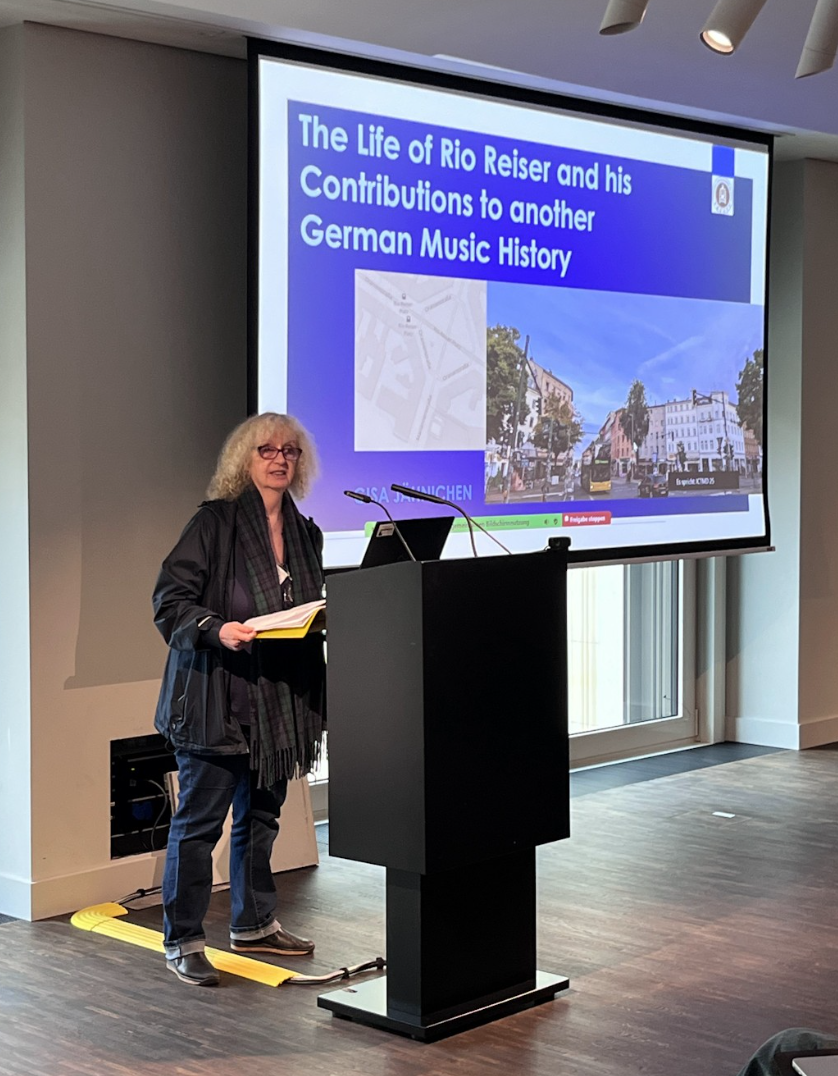
Abstract: This abstract extendsanotherformertry. In the centre of attention, there is Rio Reiser (1950-1996), a Berlin famed composer and musician, who tried to evade nation practices that are as common as nationalist approaches to owning music, whether this music is based on contemporary or traditional ideas. This study is to analyse “the music itself” with alltheirinherent historical lines leading to“Volkstumlichkeit” by using specific musical instruments and the connection to the music’s usefulness in the context of evading conflicts. As music may have some structuring elements that can be interpreted discretely and only become fixed through using these elements in socializing with a defined group of people, one can easily find the underlying processes. Special importance is given to a conditional songtext analysis,thatincludes all elements of singing, not only the core text, and the instrumental arrangement. As an instance serves the analysis of Rio Reiser’s “Konig von Deutschland” for different agendas of the music band “Ton, Steine, Scherben”, that represented a specific time and political orientation of the “folk”. Methodologically, information from those involved in social and migration problems of Berlin’s Kreuzberg-Friedrichshain will also be included, who will be given the opportunity to express themselves appropriately in open interviews.
来自音乐学系的萧梅教授发表了《赛努拜尔·吐尔逊和她的“全球时刻”》(Snuber Tursun and her Global Moments),该文通过新疆维吾尔族著名歌手赛努拜尔为印度诗人泰戈尔诗作谱曲的微型民族志,将音乐家在新疆多民族文化融合土壤上的成长、20世纪后半叶多民族语言翻译史与传主创作特征的音乐分析相结合,试图以一个小故事切入微观全球史的写作。
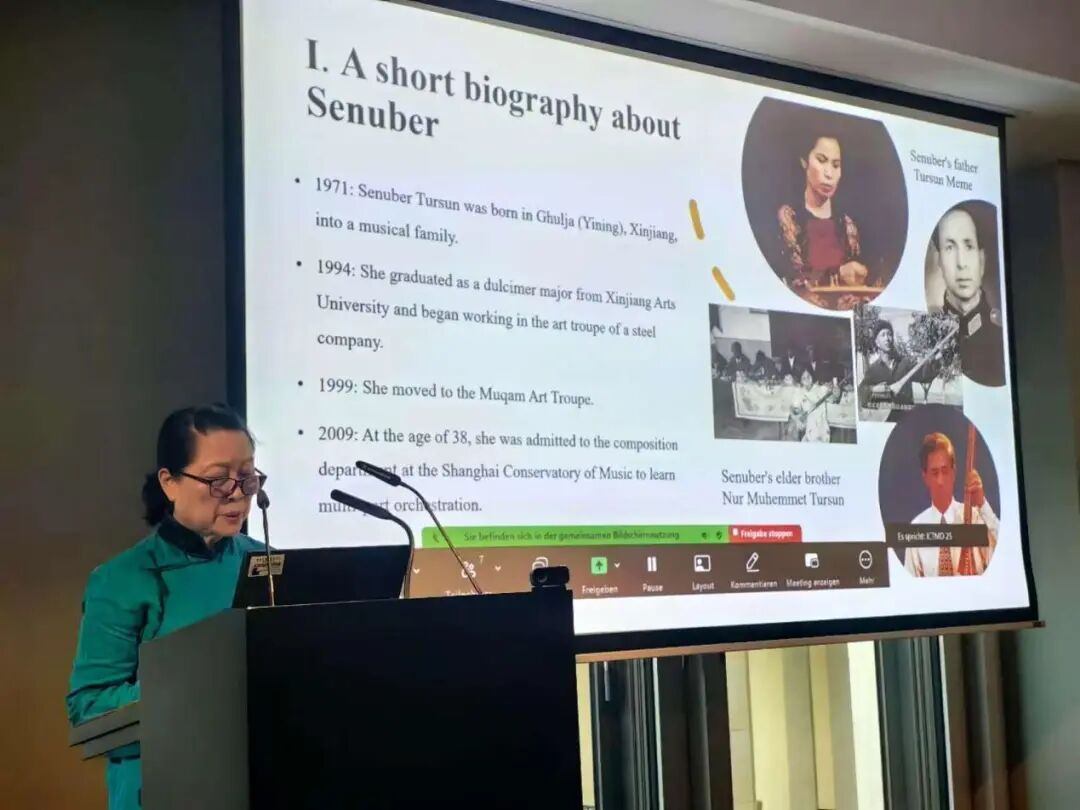
萧梅教授在发言中
Abstract: This abstract extends the scope of the former symposium We often revere those Prominent Personalities in the History of Music and Dance Heritage because their contributions illuminate the cultural peaks of a nation or community. These peaks are not isolated cultural entities but leave unique and irreplaceable "global moments" on the map of music history. Unlike the "global moments" highlighted in Western-centric music historiography, exemplified by figures such as Bach, Mozart, and Beethoven, these individuals gain global significance through transcending local experiences, crossing cultural boundaries, and connecting to the global network via their creative performing activities. This micro-historical perspective is essential for understanding global music history. This paper will explore the "global moments" of a nation's prominent figures by examining the case of Uyghur musician Sanubar Tursun. Renowned for her profound artistry and deep connection to her cultural roots, Sanubar Tursun has become a vital bridge between the local and the global. By composing music to the poems of Tagore, Abai Qunanbaiuly, Sergiy Yesinin, and others, she not only celebrates the literary and cultural heritage of various countries, eras, and ethnicities but also creates a rich mosaic of musical dialogues. Her work exemplifies how an artist can transcend cultural and geographical boundaries, fostering a global appreciation of diverse musical traditions and thus creating unique and irreplaceable "global moments."
本次研讨会采取线上线下的结合方式。开幕式上有三位本领域的卓越学者安东尼·西格(Anthony Seeger),阿塔什·索内邦(Atash Soneban),蒂姆·瑞斯(Timothy Rice)为研讨会专门录制了致辞,以“现身说法”的方式表达了它们对传记研究的理解。征得会议主持者的同意,该致辞视频作为本报告的文末彩蛋分享给大家。
END
编辑:林雅仪
审核:徐欣